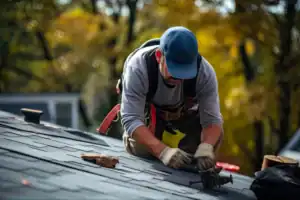
Not every roofing issue calls for a full-slope replacement. But when damage covers a large area—or when visual consistency and code requirements can’t be met by repairing only the affected shingles—a full replacement may be the most practical solution. Understanding when replacement is truly necessary helps prevent over-scoping and supports fair, data-informed decisions.
Part 1: What Is a “Slope” in Roofing?
In roofing, a “slope” (also referred to as “facet” in some cases) refers to a single, continuous surface of the roof that angles downward—often from a ridge to the eave. Each slope functions as its own section, and damage or repairs are often assessed by slope rather than the entire roof.
Part 2: Why Individual Slope Replacements are Common
Individual slope replacement allows you to repair roof damage that is localized to a single (or a few) slope. A proper slope repair leaves roofs structurally sound and returns them to their pre-damaged condition.
Part 3: Common Reasons for Slope Replacements
The cause and scope of damage on the roof can be a primary factor in determining whether repairs can be performed successfully by replacing the affected slopes. Here are some common causes of damage that lead to the replacement of an entire slope:
Straight-line wind damage
Falling debris
Small hail with wind
Shingle matching considerations
Code Threshold Exceeded
Part 4: Slope Replacement Considerations
Decisions around slope replacement aren’t just about damage—they’re also about what’s possible and what’s visible. If materials aren’t available for a seamless match, or if the slope is large and highly exposed, replacement may be the best option to ensure a uniform, lasting result.
Material Availability and Color Match
Roofs should always be repaired with materials of equal or greater performance. But different states have different policies on aesthetic matching.
Location of the Damage
Damage on certain areas of the roof are considered more difficult to perform a local repair.
Part 5: Key Techniques
Removing the Shingles from the Damaged Slope(s)
1. Prep the Slope
2. Loosen the Ridge Cap
3. Work Top-Down
4. Continue Row by Row
5. Inspect the Decking
Ridgecap Considerations
1. Score Sealant Lines
2. Remove Nails
3. Preserve or Replace
Part 6: Identifying a Matching Shingle
Finding a shingle that truly matches by color and construction is critical to both the look and long-term performance of a repair. When expert matching services like itel aren’t available, here are some field-tested tips to help you identify the closest match on your own.
Steps:
1. Check the Shingle Code
Look for identifying marks such as the manufacturer code or color code printed on the bundle or the back of a sample shingle.
If available, reach out to your local supplier or the manufacturer with these codes to see if they can help you source the closest matching product.
2. Consider Manufacturer Color Codes (If Available)
Some manufacturers, such as GAF or CertainTeed, include color codes that can help identify the original shingle color. While you won’t be able to match the exact production lot, using the manufacturer’s color information as a reference can help minimize visible contrast in the repaired area.
3. Compare Side-by-Side in Natural Light
Lay new and existing shingles side-by-side in daylight and from multiple viewing angles. Evaluate how well the colors and granule blends align—especially under direct sunlight.
Keep in mind that shingle color naturally changes over time as it weathers, so newer shingles may initially appear brighter or cleaner. With exposure, they will typically fade and blend in more evenly.